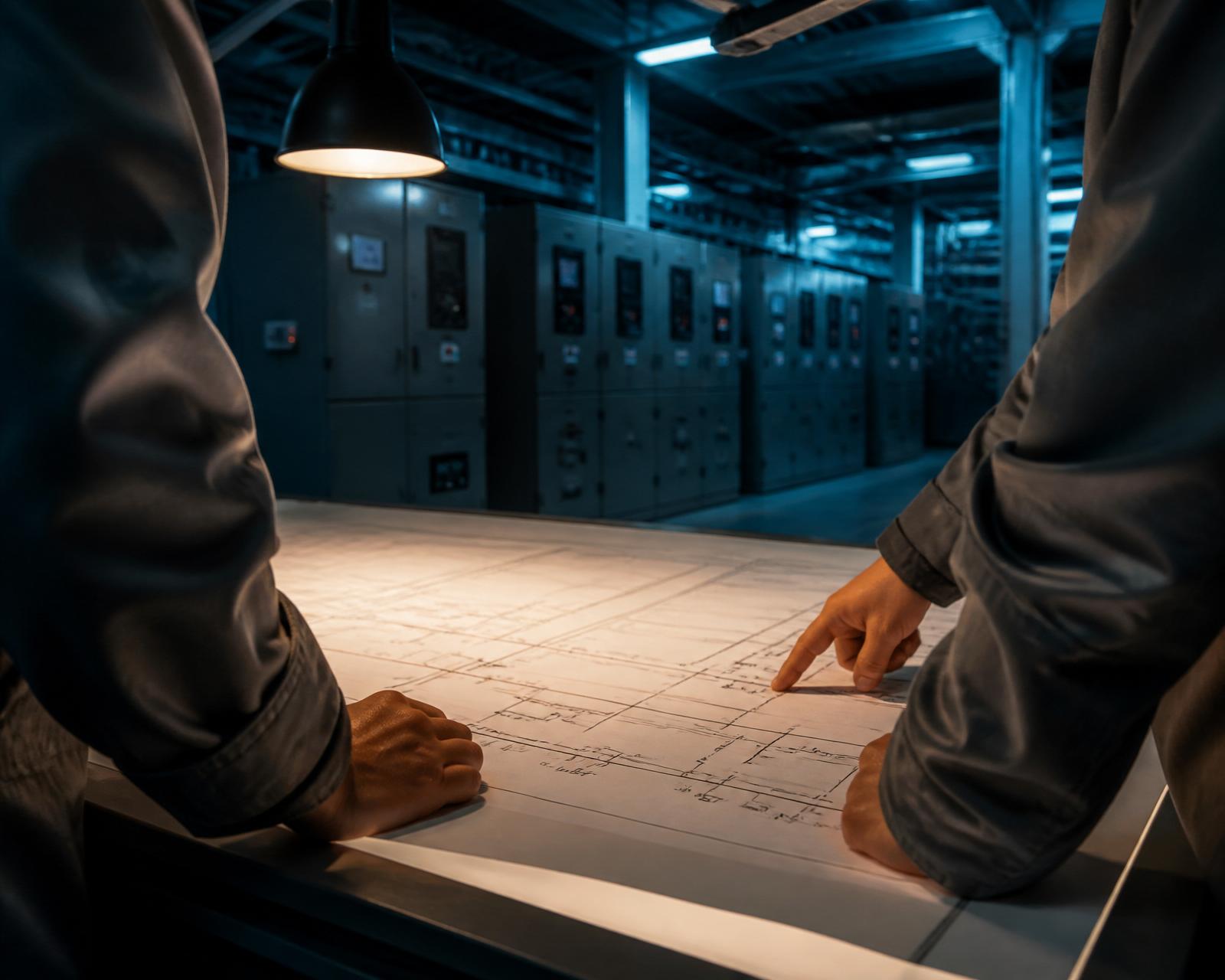
An electrical engineering team focused on sensitive operations
EOS Électricité is an electrical engineering partner focused on complex installations. We work on electrical design, integration and operation of infrastructure where availability, safety and performance are non-negotiable.
Our approach combines field installation expertise, engineering study capability and an operator's mindset: every architecture is built to last, to be maintained simply and to evolve with our clients' activity.
We address these challenges through a complete portfolio of electrical engineering solutions and specialised sectors.
Securing our clients' critical power supply
Guaranteeing the continuity, safety and performance of the electrical infrastructure that keeps real-world operations running.
We put our engineering at the service of organisations where an outage, a non-compliance or a design flaw has immediate operational, human or financial consequences. Our mission is to translate those requirements into robust, documented electrical architectures that stay under control throughout their entire lifecycle.
Electrical engineering as a lever for lasting performance
Turning electrical infrastructure into a strategic asset, not just a cost line.
We believe that rigorous electrical design, combined with the right bespoke energy solutions, allows organisations to improve their operational continuity, reduce consumption and calmly prepare their sites for what comes next — new uses, electrification, decarbonisation.

The compass points guiding our engineering decisions
Seven values shape the way we study, design and deliver our electrical infrastructure projects.
Reliability
Redundant architectures, sized with margin, tested and documented to hold up over time.
Safety
The safety of people, assets and operations is built in from the very first lines of study.
Engineering excellence
Standards-driven rigour, argued technical choices and systematic review by experienced engineers.
Energy efficiency
We systematically look for performance gains: neutral schemes, control, losses and power factor.
Bespoke
Every site has its own constraints. We refuse to force off-the-shelf solutions onto singular operations.
Long-term partnership
We stay alongside our clients well beyond commissioning, throughout the life of their installations.
Operational continuity
Power availability is treated as a design objective, not a hoped-for outcome.
The technical convictions behind every EOS project
Six principles frame our practice of electrical design, from the earliest study through hand-back to operations.
Our projects are not assembled from templates. Each electrical infrastructure is studied from the site's real constraints, its critical loads and its operational profile. These six principles frame that approach.
- 01
Tailored engineering over standardised solutions
We start from the real need — use, criticality, environment, evolution — to define the right electrical architecture. Equipment choices, earthing regimes, distribution schemes and backup strategies are argued case by case.
- 02
Operational continuity by design
Availability is designed in, not retrofitted. Redundancy, sectioning, backup, transfer procedures and degraded modes belong in the master scheme before any equipment selection.
- 03
Long-term maintainability
An installation only creates value if it can be operated simply. We take care with access, labelling, documentation and component standardisation to keep maintenance and future changes straightforward.
- 04
Safety integrated across the lifecycle
People safety, asset safety, operational safety: we address all three from the study phase through commissioning and into intervention procedures.
- 05
Performance and efficiency from the outset
Energy optimisation is not a separate workstream: it is decided by the architecture, sizing, equipment choices and control strategy defined at the design stage.
- 06
Collaborative project delivery
We work in close coordination with operators, consulting engineers, main contractors and suppliers. A successful electrical project is one where technical and human interfaces are actively managed.
These principles come to life in our bespoke electrical installations and energy optimisation programmes.
Five steps to deliver electrical infrastructure under control
A structured approach, from the first conversation through ongoing operational support.
Listening and framing
Understanding the site, operational constraints, continuity stakes and energy objectives.
Study and design
Load analysis, electrical studies, architecture choices, sizing and equipment selection.
Detailed engineering
Single-line diagrams, drawings, calculation notes, specifications, technical documentation and validation.
Delivery and deployment
Works coordination, quality control, tests, commissioning and hand-over to operations.
Ongoing support
Operational support, technical recommendations, evolutions and continuous optimisation of the installation.
Three deliberate differentiators
What our clients come to us for, beyond straightforward execution.
Bespoke electrical engineering
Architectures thought through for each site, not kit variants. Our engineers argue every design choice.
Operational continuity first
We design for continuous operation: redundancy, backup, transfer procedures and controlled degraded modes.
Long-term partner
We stay involved after commissioning to evolve the installation and safeguard its performance.
These differentiators translate concretely in our responses to emergency and backup power and temporary and off-grid power.
Operations where electricity is critical
We work with sectors whose day-to-day activity depends on a reliable, safe and efficient electrical infrastructure.
Industry
Plant managers and operations managers know that industrial electrical infrastructure cannot be sized like a commercial building.
Healthcare
Hospital technical departments and biomedical managers know that a healthcare electrical installation is not reasoned like a commercial one.
Data centers
Data Center Operations teams and technical directors know that data-center infrastructure is sized by availability — not by floor area.
Public sector
Public procurement teams and technical departments know that a public electrical project is steered as much by its contractual framework as by its engineering.
Commercial & retail
Property and facility managers know that a performant commercial building is steered through measurement.
High-end residential
Architects and demanding owners know that a high-end residential installation is judged as much on its discretion as on its performance.
Construction & temporary sites
Works managers know that a site's power supply conditions its schedule as much as its safety.
Technical rigour, held end to end
Our quality commitment rests on engineering practice, not slogans.
Every project is backed by structured technical deliverables, a legible project governance and documented validations. This rigour is especially visible in our industrial installations and data centre projects.
Project governance
A structured project management approach, designed to honour technical, financial and schedule commitments.
- 01
Planning
Study sequencing, validation milestones, coordination with other trades and alignment with the site's operational constraints.
- 02
Stakeholder communication
Regular progress reviews, a named engineering point of contact and formalised escalation to the client.
- 03
Documentation
Calculation notes, drawings, specifications, test reports and as-built dossier delivered at hand-over.
- 04
Technical validation
Design review, cross-check of sizings and senior-engineer sign-off on key choices before execution.
- 05
Change management
Every mid-project change is tracked, assessed for technical and budgetary impact, and validated before implementation.
Typical engineering deliverables
Depending on the project scope, our engagement can produce a range of technical deliverables. The most frequent are listed below.
Electrical studies
Load balance, discrimination, short-circuit, voltage drop, earthing regime and standards compliance checks.
Single-line diagrams
Clear representation of the distribution architecture, protection scheme and backup connection points.
Technical documentation
Equipment specifications, execution drawings, operating manuals and as-built dossier.
Commissioning support
Tests, adjustments, transfer trials, continuity checks and hand-over to site operations teams.
Technical recommendations
Reviews of existing installations, evolution proposals, reliability plans and energy optimisation opportunities.
This list is indicative. The exact content of the deliverables is defined with the client, based on the project scope and operational expectations.
What our contacts ask before committing to a project
A few markers to situate our scope of work and the way we operate.